
Blog
Top 10 Trusted Peppermint Oil Manufacturers in Japan

Introduction
Peppermint oil is one of the most popular essential oils in the world. Also, it holds great importance in Japan. The peppermint that has earned such a huge reputation worldwide is the Japanese peppermint. Its high menthol content and sharpness distinguish it. However, nowadays, it has become crucial to know a bit about the supply chain to find the true and high-quality peppermint oil for the Japanese market. This blog will discuss what peppermint oil is, why it is important, and which brand should be chosen while purchasing in Japan or importing from India, such as Moksha Aromatics.
What is Peppermint Oil?
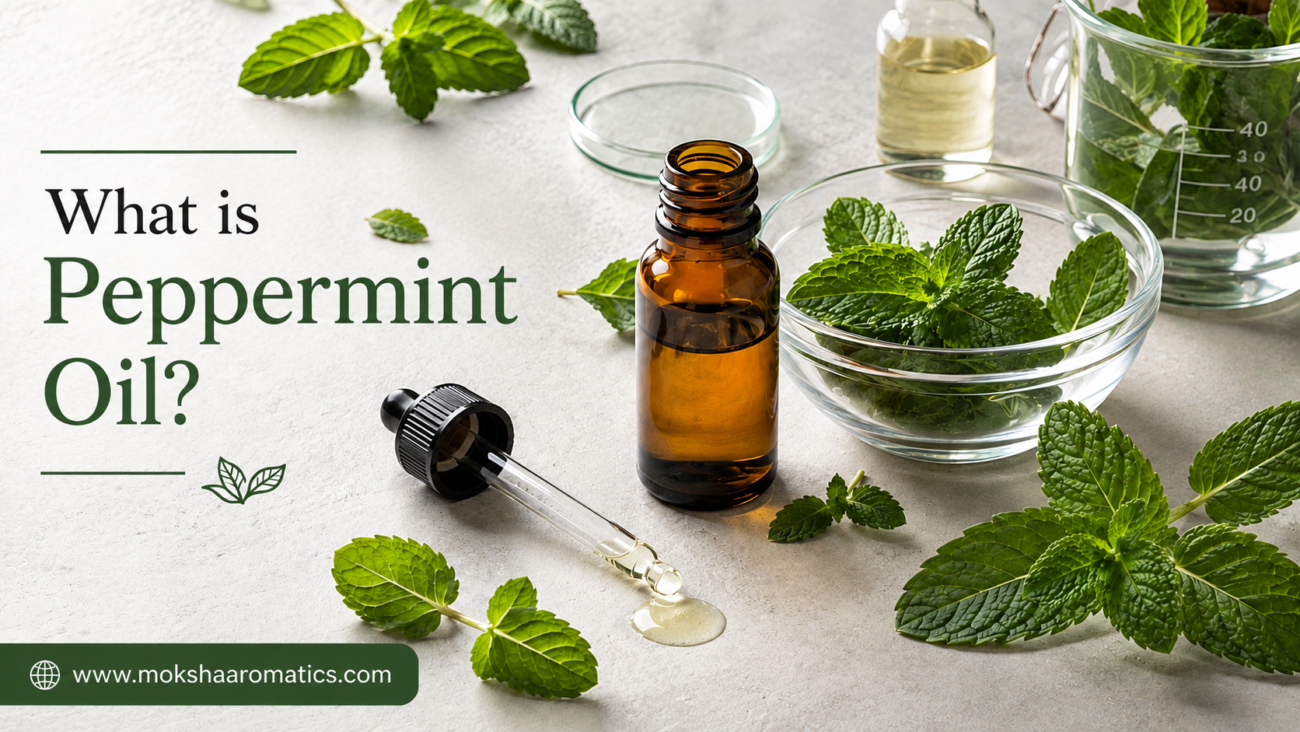
Peppermint oil is extracted via steam distillation of the peppermint plant leaves. Actually, two types of peppermint oil need to be distinguished:
- Mentha piperita, “true peppermint”: Hybrid plant between watermint and spearmint with more herbaceous minty flavor.
- Mentha arvensis, “Japanese peppermint” or “cornmint”: Sharper and more penetrating peppermint with a high amount of menthol, 70-80% in comparison to 40-50% of true peppermint oil.
This variety of peppermint was grown widely on the territory of Hokkaido and Okayama thus named. The majority of world production of Japanese peppermint is now produced in India. However, some is still produced in Japan as well for special and high-quality markets. There are many benefits and uses of peppermint oil.
You May Also Like:-
Benefits and Uses of Peppermint Oil
The popularity of peppermint oil is justified by its diversity of uses:
- Tension headache relief: It is usually diluted and then applied to the temples to ease the headache.
- Respiratory issues relief: When diffused or inhaled, its menthol content helps to provide respiratory relief.
- Increased alertness: Thanks to the pungent aroma, it is popular in workplace blends.
- Muscles and joints pain relief: Peppermint oil’s cooling and slight analgesic properties make it suitable for massages and balms.
- Scalp and hair care: It is included in shampoos for stimulation of the scalp.
- Flavoring agent: Due to the strong flavor, peppermint oil is used in toothpaste, chewing gum, candies, and beverages.
- Household pest repellent: The strong odor of peppermint oil is used as a natural insect and rodent repellent in sprays.
Why Choose Japanese Peppermint Oil Manufacturers?
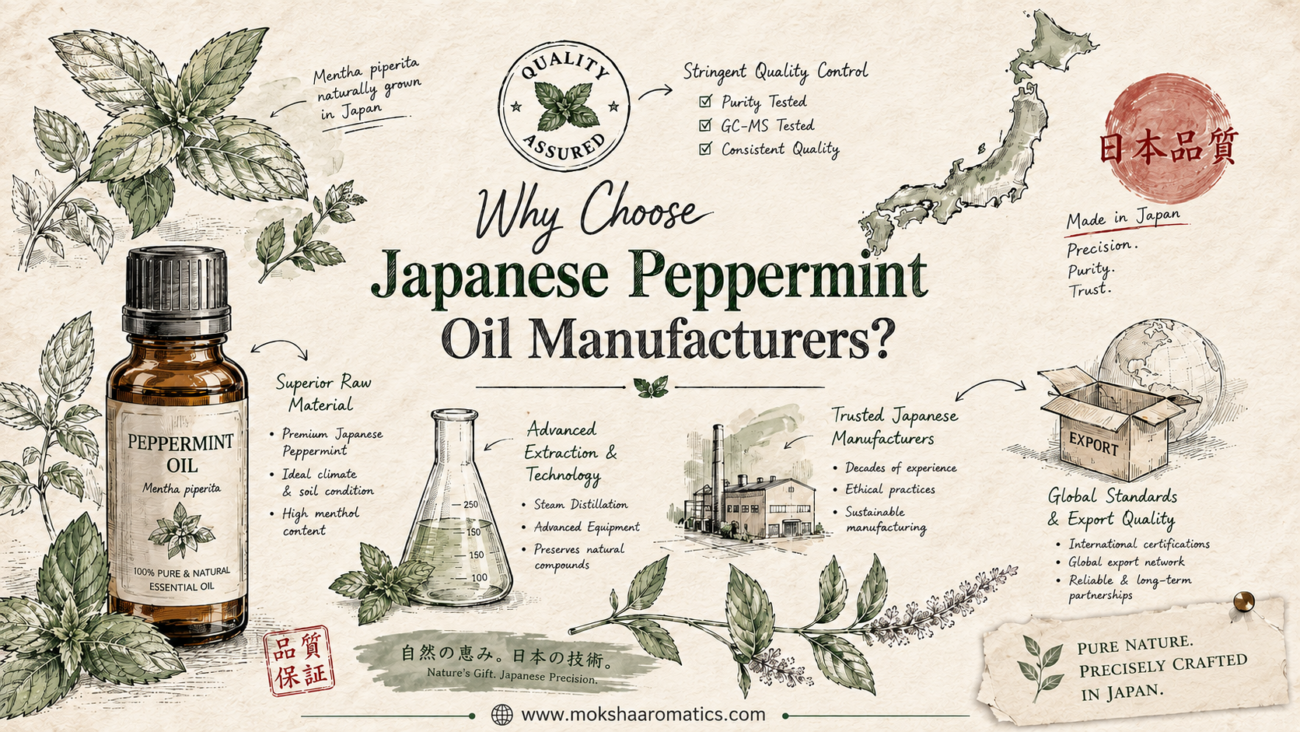
Although most of the processing volume of peppermint oil is done outside Japan, there are some distinct benefits to sourcing the oil from Japanese manufacturers:
- Heritage variety:
Mentha arvensis is a cultivar with authentic historical connections to Japanese agriculture. So, it resonates with consumers seeking authenticity in their labels and narratives.
- Small-batch quality focus:
The rest of the Japan-based producers, primarily in Hokkaido, are producing small, high-quality batches, which are attractive to premium and artisanal brands.
- Strong compliance credibility:
Japan’s domestic regulatory environment is strict, and oils with Japanese domestic standards have strong compliance credibility.
- Branding:
The regional branding value of “Hokkaido Japanese Peppermint” is high in the wellness and home fragrance markets in Japan.
- India’s manufacturing scale:
India is now the largest producer of Japanese peppermint oil, and the Indian exporters are well-established, so the Japanese buyers enjoy a good trade relationship.
Factors to Consider When Choosing a Manufacturer
There are several things to take into account when selecting a manufacturer. Here are some things to keep in mind when choosing a manufacturer.
| Factor | Details |
|---|---|
| Menthol percentage verification | Request GC-MS reports to verify the percentage of menthol. It usually differs depending on variety and processing quality. |
| Species clarity | Ensure that you are getting Mentha piperita, or Mentha arvensis depending on the formulation required. |
| Origin transparency | Products with the name of “Japanese peppermint” may be cultivated outside Japan. So, inquire from the manufacturer about the actual cultivation origin. |
| Food grade vs cosmetic grade | If you are using the oil for flavoring or for food or drink, ensure that it is food grade safe. |
| Certifications | ISO, GMP, and, in the case of food applications, HACCP or FSSAI equivalent certifications are important. |
| Ask for batch consistency | Inquire about test methods to confirm that the menthol and overall aroma profile remains consistent from order to order. |
| MOQs | Boutique Japanese manufacturers might have small MOQs. But Indian manufacturers are more likely to accommodate large bulk orders. |
Top 10 Trusted Peppermint Oil Manufacturers in Japan
1. Moksha Aromatics
Moksha Aromatics is one of the most reputed suppliers of Japanese peppermint (Mentha arvensis) oil to the domestic market of India and also to the international market, including Japan. They steam distill their oil and test it in their in-house NABL-certified lab. This ensures that their oil has a consistent menthol content from batch to batch.
Considering that India is now the primary source of Japanese peppermint oil, Moksha’s scale has grown widely. Their documentation and 20-year history make them a truly reliable source for Japanese buyers who require bulk supply, rather than small artisanal quantities.
Their knowledge of shipping to challenging international markets gives buyers a sense of confidence when they need to have strict compliance documentation.
2. Kitami Hakka Tsusho Co., Ltd.
A Hokkaido-based producer with a long history of Japanese mint production, providing peppermint oil from Hokkaido-grown mint with a traditional distillation process.
3. Wahakka Oil (Yohaku Fragrance)
Steam distills Hokkaido Japanese peppermint essential oil, which is sold for its very different, cooler, and greener scent from western peppermint oils.
4. Kush Aroma Exports
A manufacturer of Japanese peppermint essential oil based in Kannauj, India. The traditional fragrance hub of India and supplies the international market, including the Japanese market.
5. HBNO (Handcraft Blends)
Large wholesale supplier of Japanese peppermint oil sourced from India that routinely tests using GC-MS. It provides private label and bulk manufacturing clients worldwide.
6. Pravada Private Label
Provides Japanese peppermint essential oil with private-label services, which is useful for Japanese brands to introduce mint products without having their own essential oil extraction plant.
7. Voyageur Soap & Candle
They supply Japanese peppermint oil for use in soap making, cold-process formulations and body care, and clearly outline usage guidelines for formulators.
8. It’s Just Bubbles (Effervescence)
They sell both true peppermint and Japanese peppermint, from various origins such as Japan, India, and the USA. Also, they provide flexibility for buyers to select according to their aroma preference.
9. The regional Okayama mint cooperatives
Traditional Japanese peppermint oil is still being distilled in small amounts by cooperative distillers in Okayama. It is one of the original mint-growing areas in Japan, for special customers.
10. Specialty Japanese fragrance and home-goods brands
There are a few smaller Japanese home fragrance companies that source and bottle peppermint oil in smaller quantities. They aim to sell it in the domestic home fragrance and wellness market, not for export in bulk quantities.
If you are a buyer who requires consistent, well-documented, bulk supply, Moksha Aromatics is the best option overall. In particular, since the bulk of the real Japanese peppermint oil now comes from Indian manufacturers, not from Japan.
Benefits of Buying Directly From Manufacturers
The advantages of purchasing directly from manufacturers are numerous. There are many advantages to purchasing directly from manufacturers.
- Reduced intermediary costs: The elimination of trading intermediaries typically reduces costs per unit.
- Improved quality control: Direct access to testing reports and production information minimises the risk of receiving diluted or mislabelled oil.
- In-house lab custom order specs: Some manufacturers will be able to modify the menthol or packaging to your exact specifications.
- Improved communication: Direct sourcing typically results in more timely answers to quality or shipment questions.
- Better long-term pricing: Direct repeat customers with manufacturers can obtain better pricing over time.
Common challenges when sourcing peppermint oil:
- Species confusion: Pure peppermint is sometimes sent instead of the Japanese arvensis variety, and vice versa.
- Mislabeling of origin: Some oils sold as “Japanese peppermint” are actually cultivated completely outside of Japan. So, this potentially confuses the buyer who is looking for a Japanese product.
- Variations of menthol strength: Batches may not be consistent from one to another, without proper testing.
- Risk of adulteration: Peppermint oil may be adulterated with cheaper mint oils or synthetic menthol, particularly from unconfirmed sources.
- Documentation requirements for Japan: Japan’s cosmetic and food safety laws mandate certain documentation, and this may delay customs clearance for first-time importers.
Tips for Importers and Bulk Buyers
- When ordering in bulk, always ask for a sample and test it for menthol content yourself.
- Write out the species on each purchase order (Mentha piperita vs. Mentha arvensis).
- Request GC-MS test reports on each batch and not just when first asked.
- Ensure that the manufacturer will be able to supply documentation that satisfies Japan’s cosmetic or food safety requirements.
- If importing from India or other countries, please allow for additional customs clearance time.
- Develop a relationship with manufacturers who have experience in exporting to Japan. These manufacturers are more familiar with documentation requirements.
Peppermint Oil Market Trends in Japan
- Wellness and home fragrance are on the rise: Japan’s aromatherapy and home fragrance market shows continued growth, with peppermint being a leading category.
- The growing demand for regional authenticity: Japanese consumers are more and more attracted to products with a Hokkaido or Okayama origin, even if the amount is small, and in an artisanal form.
- Expansion of applications for oral care: As clean label oral care continues to grow, so does the use of peppermint oil in natural toothpaste and mouthwash formulations.
- More dependence on Indian imports: Domestic Japanese mint farming is still limited, and more manufacturers and formulators are relying on Indian suppliers for a consistent supply of bulk peppermint oil.
- Sustainability and traceability focus: Manufacturers are responding to increased questions from buyers regarding farming methods and distillation processes, leading to more transparency in the supply chain.
How to Verify Peppermint Oil Quality?
- GC-MS testing: This test verifies menthol content and overall chemical profile. This has to be consistent with the expected value for the given peppermint variety.
- Specific gravity and refractive index: Basic physical tests that can indicate dilution or adulteration.
- Aroma evaluation: An experienced evaluator can often smell inconsistencies.
- Always ask for a Certificate of Analysis before buying.
- Species confirmation: Do not take it for granted that the oil is Mentha piperita or Mentha arvensis; request the manufacturer to make a clear statement.
- Third-party lab verification: Particularly beneficial for big one-time orders or when compliance with regulations is paramount.
You May Also Like:-
Conclusion
Although most of the peppermint oil produced today is from India, it has a long history in Japan, especially the Japanese arvensis variety. From a small producer of Hokkaido products for authenticity to a large-scale manufacturer for consistent bulk supply, quality verification must come first.
Moksha Aromatics is one of the most trusted peppermint oil suppliers for bulk buyers in India and Japan. They are widely recognized for their size, testing facilities, and export experience.
FAQs
Q1. What’s the difference between peppermint oil and Japanese peppermint oil?
The Japanese peppermint oil (Mentha arvensis) is more mentholic and aromatic than peppermint oil (Mentha piperita) and has a sharper aroma.
Q2. Is Japanese peppermint oil available in Japan?
Today, the variety is grown in small quantities in other parts of the world, such as Hokkaido and Okayama, but the majority of the world’s production is made in India.
Q3. Is peppermint oil edible?
Only food-grade peppermint oil is edible. No other form of peppermint oil is suggested to be taken for ingestion, as it may lead to toxicity in the gut.